


There are many opportunities for advancement in the construction industry, but you won’t succeed if you don’t have the right attitude, job training, and network. In this article, you’ll learn how to prepare for advancement opportunities as you start, pursue, and progress your career in construction.
Gaining experience in a construction career can lead to exciting promotion opportunities and other lucrative careers. Unless you want to remain stagnant in this field, it’s time to make a plan! If you’re ready to maximize your career progression in construction, we encourage you to follow these five tips:
How to Grow Your Career in Construction
1. Develop Your Skills
When you start your career in construction only knowing a handful of skills, you may find yourself stuck in the same job. To progress, you will have to continue to develop your skills.
You can take courses at a community college or university, find a mentor, join an apprenticeship program, or simply learn from the people you work with.
If you don’t know how to do something, take the time to learn. This will make you a highly valued worker in the construction industry.
2. Take Charge
By showing initiative, you can demonstrate your ability to be innovative and assertive.
Companies will notice your readiness to adopt new technologies and procedures and take control of situations as they arise.
Doing so will put you on their radar for promotions!
Just make sure you don’t step on any toes while doing so. You need to maintain respect for the work hierarchy but don’t be afraid to share your ideas with your supervisors and managers.
3. Network
Along with the right work attitude and skills, having a network will open you to more possibilities in your construction career.
Get to know construction professionals such as contractors and architects and build relationships with them.
This way, when jobs become available, these individuals will reach out to you so you can progress your career.
4. Focus on Quality
In the construction industry, quality is essential, and it’s crucial not to take shortcuts to save money and look impressive!
Be sure to focus on doing a high-quality job within the project’s budget.
While finishing a project under budget may seem appealing to your bosses, shortcutting customers can tarnish their reputation. Make it your priority to represent your company to the best of your abilities, and it won’t go unnoticed!
5. Goal Setting
You can’t progress your career in construction if you don’t know where you’re going! What do you want in the end? Having a long-term goal will help define your path to success and provide a sense of completion.
Having a long-term goal will encourage you to work hard to attain them.
If you’re not sure what you want in the future, think about short-term goals. What do you want to do next? From there, you can start to formulate a career path.

What is the Construction Industry?
The construction sector is involved with the design, development, and maintenance of residential, commercial, and industrial buildings. Construction industry members, including general contractors, construction workers, construction laborers, construction managers or project managers, and construction trades, create and maintain structures such as homes, roads, bridges, and utility systems.
While many people may think of the construction industry only as it relates to new construction, professionals within this industry may also work on projects involving additions, remodels, repairs, and maintenance of existing buildings and structures.
What Are the Sectors Within the Construction Industry?
There are four major sectors within the construction industry: residential construction or homebuilding, institutional and commercial building, specialized industrial construction, infrastructure, and heavy construction.
Residential Housing Construction
Residential housing construction involves building, repairing, and remodeling structures for housing people, supplies, or equipment. The sector includes new buildings, apartments, townhomes, condos, nursing homes, dormitories, etc. Residential construction job site projects also involve repairing and installing utilities around the structure.
Specialized Industrial Construction
Specialized industrial construction entails building structures that require a high level of specialization and technical skills in planning, construction, and design. Typically, for-profit or industrial corporations carry out this type of construction. For instance, oil refineries, nuclear power plants, and hydroelectric power plants are all examples of specialized industrial construction.
Institutional and Commercial Building
Institutional and commercial building involves construction projects such as schools, sports arenas, shopping centers, hospitals, stadiums, retail stores, and commercial buildings like skyscrapers. Like residential housing construction, institutional and commercial building involves putting up new structures and repairing and maintaining existing structures.
Infrastructure and Heavy Construction
Infrastructure and heavy construction encompass the building and upgrading of railways, communications, and roads. Some other construction site projects that fall under this type of construction include tunnels, bridges, highways, transit systems, drainage systems, and pipelines.

What are the Most Popular Jobs in Construction?
The most popular jobs and professional careers in the construction field can be split into three categories: executive, mid-level/middle management, and specialty roles. Some positions will require a college degree, while others have great apprenticeship programs available for those with a high school diploma and new to the industry.
Executive Positions
- Civil Engineer
- Safety Director
- Construction Engineer
- Building Services Director
- Senior Manager
- Chief Construction Officer
- Project Manager
- Director of Construction
- Construction Manager
- Estimator
- Safety/HSE Manager
- Superintendent
- Land Development Manager
- Business Development Manager
Mid-level/Middle Management Positions
- Quantity Surveyor
- Project Manager
- Architect
- Architectural technologists
- Building Services Engineer
- Structural Engineer
- Building Inspector
- Purchasing Coordinator
- Construction Coordinator
- Site Manager
- Safety Manager
- Sales Representative
- Proposal Coordinator
- Structural Engineers
- Civil Engineers
Specialty Positions
- Elevator Installer/Repairer
- Electrician
- Plumber
- Sheet Metal Worker
- Carpenter
- Equipment Operator
- Mason
- Glazier
- Solar Installer
- Painter
- Ironworker/Steelworker
- Insulation Contractor
- Mechanical Contractor
- Foreman
- Builder
- Energy Auditor
What Are the Highest-Paid Careers in Construction?
According to the Bureau of Labor Statistics (BLS), Occupational Employment and Wage Statistics (OEWS), and analysis by the National Association of Home Builders (NAHB), half of the payroll workers in construction earn more than $49,070, and the top 25% make at least $75,820. The U.S. median wage is $45,760, while the top quartile (top 25%) makes at least $68,590.
The OES publishes wages for over 400 occupations in construction. Out of these, only 58 are construction trades, and the other industry workers are finance, sales, administration, and other off-site activities.
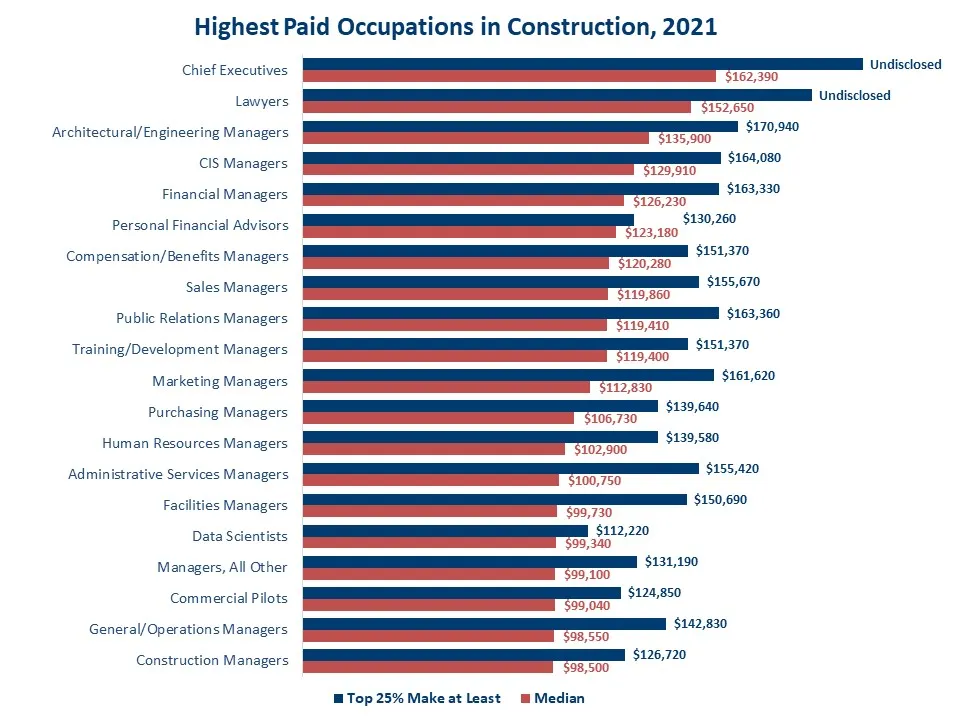
The highest-paid occupation in construction is Chief Executive Officers (CEO), with half of the CEOs making over $162,390 per year. Lawyers working in construction are next on the list, with median wages of $152,650. Of the following 13 highest paid trades in construction, 12 are various managers. The highest-paid managers in construction are architectural and engineering managers, with half of them making over $135,900 and the top 25 percent on the pay scale earning over $170,940 annually.
Among construction trades, skilled professionals and skilled workers such as elevator installers and repairers top the median wages list, with half earning over $98,600 a year and the highest-paid 25% making at least $120,950. Pile driver operators are next on the list, with half of them making over $77,030 and the top quartile earning at least $96,440. First-line supervisors of construction trades are third on the list, and their median wages are $72,600, with the top 25% of highest-paid supervisors earning more than $91,310.
In general, construction trades that require more years of formal education, specialized training, or licensing tend to offer higher annual wages. The median salaries of construction and building inspectors are $61,360, and the wages in the top quartile of the pay scale exceed $78,940. Half of the plumbers in construction earn over $59,810, with the top quartile making over $78,190. Electricians’ wages are similarly high.
Carpenters are one of the most prevalent construction crafts in the industry, and the trade requires less formal education. Nevertheless, the median wages of carpenters working in construction exceed the national median. Half of these craftsmen earn over $48,420, and the highest-paid 25% bring in at least $62,370.
With these estimates, the OEWS program adopted a new estimation methodology. As a result, the previously published estimates are not directly comparable to the latest 2021 edition. While the recent methodological changes prevent direct comparison with the earlier estimates, the new design is expected to improve the data users’ ability to compare occupational wages across years in the future and better access the changing demand for particular occupations in the labor market.
Career Advancement Opportunities in Construction
Working in construction is not a dead-end job – there are many opportunities for advancement! Career change opportunities are plentiful with many equal opportunity employers with excellent job stability, such as general contractors, construction firms, and homebuilders.
While you can begin your new career with an entry-level position in construction straight out of high school, you can further progress by seeking out apprenticeships and higher education while developing your specific skills and working your way up the ladder.
Even though the path to success in construction is not an easy one that happens overnight, you can maximize your career progression in this exciting industry by developing your skills, taking charge, trying new jobs, networking, doing quality work, sheer hard work, and setting goals!
Let MatchBuilt Help You Start Your Dream Career
If you’re ready to get started with your stable career in construction, be sure to check out our career development tips and up-to-date job postings for various construction-related roles.
